Unlocking Healthier Hair
Low-field NMR Reveals the moisturizing power of PinoPlex™
When it comes to haircare, consumers look for products that truly deliver on their promises—especially when dealing with dryness, damage, or chemical treatments like bleaching. But how can brands scientifically prove that an ingredient really improves hair hydration and structure?
A cutting‑edge technology called low‑field NMR (Nuclear Magnetic Resonance) is helping answer that question.
NMR may sound like something reserved for high‑tech laboratories, but Cerevaa has adapted it into a practical tool for the cosmetics industry and used it in collaboration with Mibelle Biochemistry optimizing PinoPlex™.
Low‑field NMR allows scientists to look inside the hair fiber without damaging it. It provides two crucial pieces of information:
1. Total Proton Content = Hair Hydration
Water (chemical symbol is H2O) inside the hair contains hydrogen atoms (“protons or H”).
More protons detected → more water absorbed by the fiber means more moisture
2. Proton Mobility = Hair Structure & Water Binding
Low mobility means water molecules are held more tightly, indicating:
- better water retention
- smoother, more structured hair fiber
Together, these NMR insights create a clear picture of how effective a haircare ingredient truly is.
To demonstrate the technology’s power, two cosmetic actives were tested on bleached (sensitized) hair tresses, comparing:
- untreated hair
- placebo (water)
- Active A (PinoPlex™)
- Active B
Each active was used at just 1%, reflecting real‑world cosmetic formulations.
Results
1. Strong Moisturizing Effect
PinoPlex™ led to a +12% increase in total proton content—meaning the hair absorbed significantly more water.
Active B showed no measurable hydration effect.
2. Improved Hair Structure
PinoPlex™ caused a marked decrease in proton mobility, indicating:
- stronger binding interactions
- better water retention
- a reconstructed internal fiber structure
In simpler terms: hair became smoother, stronger, and shinier.
Active B again showed minimal effect.
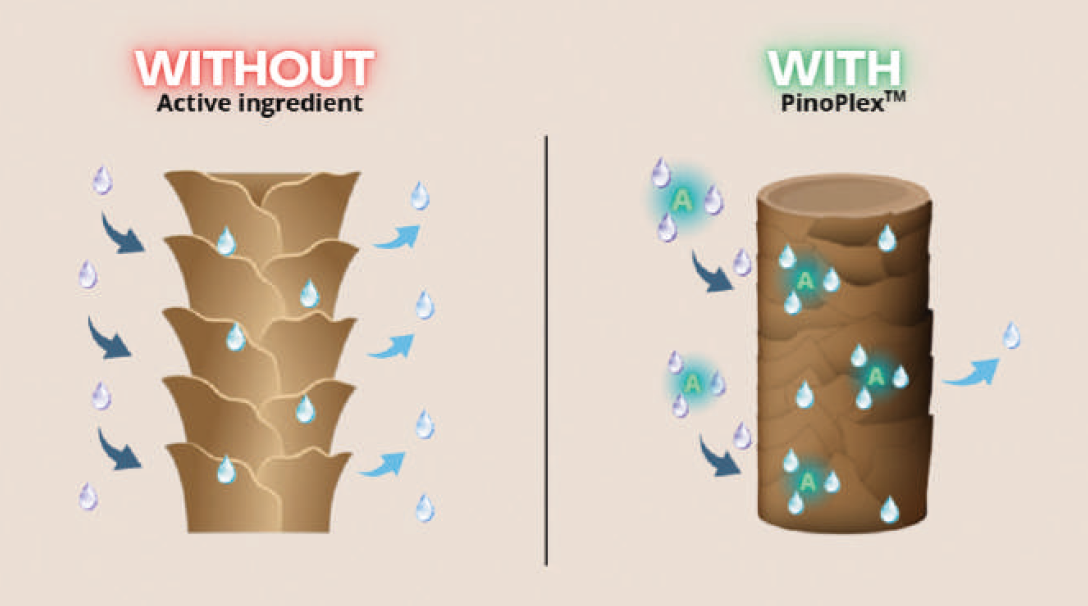
Damaged hair struggles to hold onto water because its cuticles and inner keratin structure are compromised. PinoPlex™, thanks to its molecular affinity for water, helps:
- Attract moisture into the fiber
- Lock it in through stronger binding
- Repair structural damage from bleaching
- Restore hair closer to its natural, healthy state
This dual action—hydration + repair—is what sets PinoPlex™ apart.
Check out the PinoPlex™ Website to read the full paper.